CFDs and Spread bets are complex instruments and come with a high risk of losing money rapidly due to leverage. 74% of retail investor accounts lose money when trading CFDs and Spread bets with this provider. You should consider whether you understand how CFDs and Spread bets work and whether you can afford to take the high risk of losing your money.
74% of retail investor accounts lose money when trading CFDs and Spread bets with this provider.
Oil Surges Above $100 as Trump Warns Iran Over Strait of Hormuz
Posted by: KQ Analyist 15-May-2026
Share on:
Article /
Oil Surges Above $100 as Trump Warns Iran Over Strait of Hormuz
Crude oil prices jumped sharply on Friday after US President Donald Trump warned that his patience with Iran was running out, putting the fragile ceasefire and Strait of Hormuz shipping back at the centre of the market's attention.
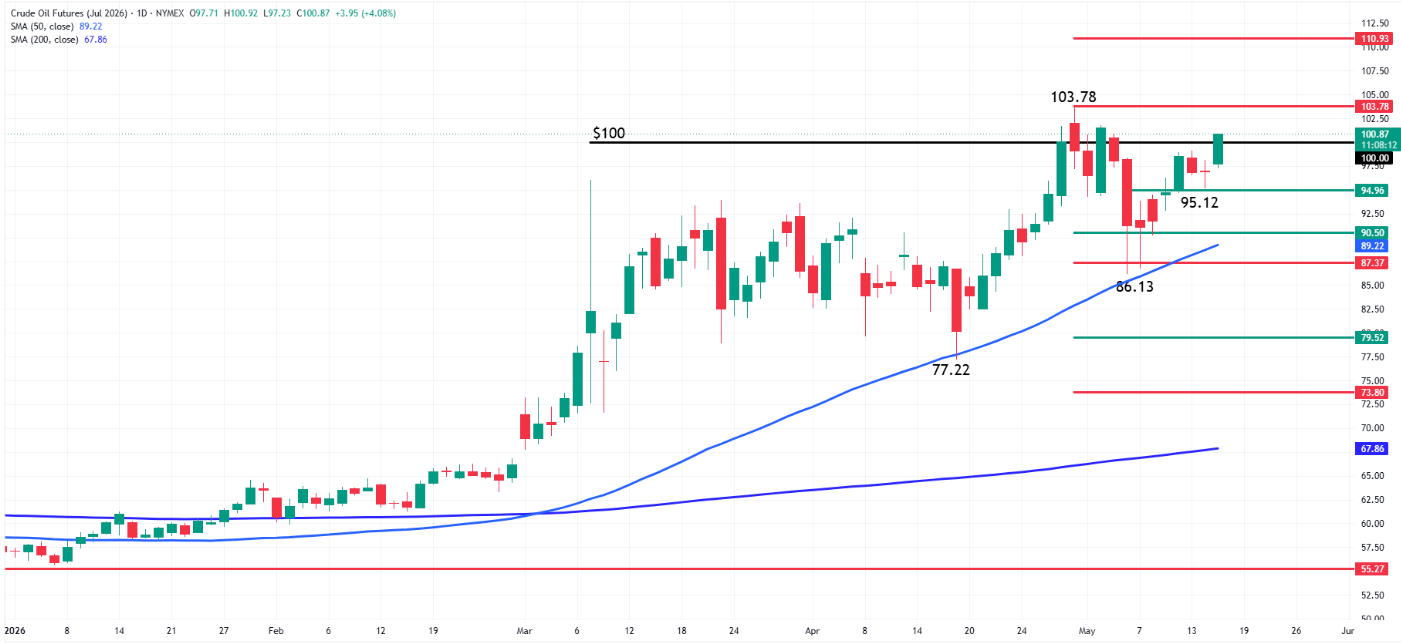
July WTI crude futures climbed to around $100.54 a barrel, up roughly 3.7% on the day, while July Brent rose to $108.68, up nearly 2%. On a weekly basis, WTI is on course for a gain of close to 10% and Brent around 8%.
What Triggered the Move
Trump and Chinese President Xi Jinping reportedly agreed at this week's Beijing meetings that Iran should not develop nuclear weapons and that the Strait of Hormuz must fully reopen to shipping. Trump then added a sharper line, saying his patience with Tehran was wearing thin.
The market read that as a clear warning rather than diplomatic language. Two days of cautious optimism about traffic resuming through the Strait unwound in a single session.
The Strait of Hormuz Picture
The numbers explain the nervousness. According to Iranian state media and shipping data, only around 10 to 30 vessels have been moving through the Strait in recent 24-hour windows. Before the conflict, the daily average was about 140 ships.
Roughly one-fifth of the world's seaborne oil passes through this narrow waterway. Anything that restricts that flow tends to feed directly into crude prices, which is exactly what is happening now.
Tight Inventories Add to the Pressure
The latest US Energy Information Administration data showed a larger-than-expected crude inventory draw, with stocks at the Cushing hub falling sharply. Gasoline inventories also declined as buyers shifted away from Gulf supply routes.
Strong US exports kept domestic stockpiles from rebuilding even as production held firm, and refiners stayed at high utilisation rates ahead of the summer driving season. The result is a market with very little spare supply to absorb further disruption.
Two Views From the Energy Agencies
The International Energy Agency has warned that supply deficits could emerge if the Gulf disruption continues, with inventories no longer offering much of a buffer heading into peak demand.
OPEC, meanwhile, has trimmed its demand growth forecast, noting that prices near $100 a barrel are starting to weigh on consumers and businesses. Production increases from member countries are not coming through fast enough to offset the supply gap created by reduced Strait traffic.
What Traders Are Watching Next
Any response from Tehran over the weekend and whether Trump follows through on his warning.
Daily shipping data through the Strait of Hormuz.
Next week's US inventory data and any signs of further crude draws.
The pass-through to inflation, which is already running hot and putting fresh pressure on the new Federal Reserve Chair, Kevin Warsh.
Higher oil prices also tend to lift the US dollar and weigh on risk assets, so the move is being felt well beyond the energy complex.
Bottom Line
The oil market is pricing two things at once: the risk that the Strait of Hormuz stays restricted into the summer, and the reality that global inventories no longer have much room to absorb shocks. Until there is a clear de-escalation, volatility around the $100 level on WTI is likely to remain elevated.
Trade Oil and Commodities with KQ Markets
Access global energy markets, gold and silver, and major forex pairs through KQ Markets' professional trading platforms.
This content is for general informational purposes only and does not constitute investment, financial or trading advice. CFDs and Spread bets are leveraged products and carry a high risk of rapid capital loss. Past performance is not a guarantee of future results. Please ensure you fully understand the risks involved before trading.